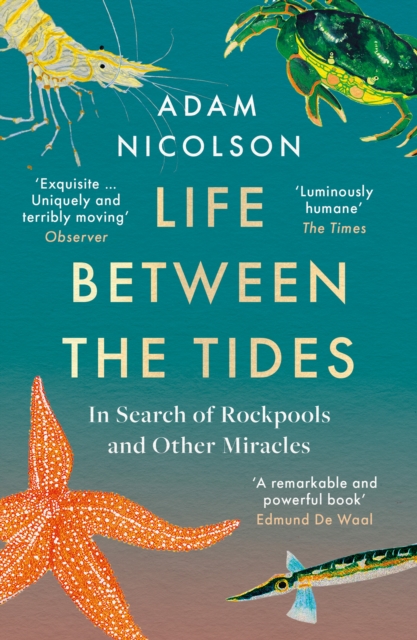
Life Between the Tides is very much my kind of book: a wonderful blend of science, history and nature writing set in a particular locale: a bay on the west coast of Scotland. Adam Nicolson explores the complex ecological relationships between the often overlooked intertidal flora and fauna that keep local ecosystems ticking over.
This book contains many fascinating details about the seemingly inconsequential behaviours of different species, and the knock-on effects they can have in the local environment. It explores, for example, how sandhoppers migrate up and down the beach twice each day in sync with the local tides; the social hierarchies and jump-reflexes of prawns; how winkles respond to particular smells; how the shapes of individual limpets’ shells are affected by the zones they inhabit; how sea anemones’ clonal colonies work together; and how the instinct of small crabs to rise and sink in the water-column just out of sync with local tides helps them to survive to adulthood. Pleasingly, Nicolson doesn’t just explain these and other phenomena, but describes how we came to understand them through the observations and experiments of dedicated naturalists and scientists.
Considering its complex subject-matter, Life Between the Tides is an admirably clear read interspersed with some wonderful literary flourishes. I particularly enjoyed Nicolson’s detailed description of a crab eating a winkle, which immediately brought to mind Charles Darwin’s description of an earthworm taking a crap. And here is part of Nicolson’s admirable description of a humble prawn:
They are very nearly transparent, glass-beings, and can look like the specks that float in the surface of your eyes, semi-seen presences, with no more than a hint of inner organs glimpsed beyond the grisaille of their armour.
After completing my book On the Moor about the science, history and nature of my local moorland patch, I toyed for a while with the idea of a sequel based on my favourite stretch of Anglesey coastline (working title: On the Shore—see what I did, there?). In the end, I opted to work on my Darwin book instead, but Life Between the Tides is very much the sort of book I had in mind—albeit written in a different voice. It should come as no surprise, therefore, that I enjoyed it very much indeed.
Highly recommended.
- Buy this book from Bookshop.org (UK) and help tax-paying, independent bookshops.
- Buy this book from Amazon.co.uk
- Buy this book from Amazon.com

Leave a Reply