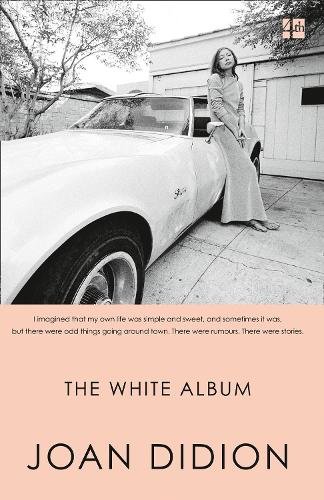
I first read Joan Didion four years ago, very much enjoying her collection Slouching Towards Bethlehem. I enjoyed The White Album too, but less so.
The main problem I had with this collection was Didion’s over-use of journalistic rhetorical devices. She might have over-used them in Slouching Towards Bethlehem too, but I don’t recall noticing them at the time. By ‘journalistic rhetorical devices’, I almost certainly mean the techniques of ‘New Journalism’, of which Didion was a well-regarded and influential practitioner.
As I understand it, the New Journalism that arose in the late-1960s and early 1970s was an attempt to make journalism more engaging by embedding the journalist and their personal views and experiences at the heart of the story, and by employing clever imagery and rhetorical tricks, rather than reporting straight facts. Like many movements named by assigning the prefix ‘new’ or ‘neo-’ to the names of older movements, New Journalism’s appeal to novelty feels ironically dated. In trying to make formerly straight-talking factual reporting into something more personal and engaging, New Journalism has clear parallels with more recent developments in ‘Creative Non-fiction’—the name and concepts of which also give rise to serious misgivings.
Didion’s opening article, The White Album, after which the collection takes its name, is clearly an important and influential piece about late-1960s and early 1970s culture. I enjoyed it very much, although the first section was heavy going, leaving me wondering where on earth the piece was heading. I also particularly enjoyed the article In the Islands about several visits Didion made to Honolulu. Didion’s chosen subject matter is sometimes unexpected—and welcome for that—for example, her piece Holy Water on Californian water-management, and a similar piece, Bureaucrats, on Californian freeway traffic-management. There is some wonderful old-fashioned straight journalism in this collection.
As I say, where I have a problem, though, is in Didion’s over-use of new-journalistic rhetorical devices. Only so often can you read a repeated phrase before it starts to jar. Only so often can you read a repeated phrase before it begins to feel formulaic. Only so often can you read a repeated phrase before you begin to wonder whether it might be OK to skip to the start of the next paragraph. Only so often can you read a repeated phrase before it dawns on you that this new journalist is probably being paid by the word. Repetition is a useful literary device, but you can get too much of a good thing.
Similarly, Didion’s over-clever phrasing occasionally gets in the way. I felt this particularly in her piece The Women’s Movement. Didion clearly has some important criticisms to make about late-1960s and early 1970s feminism, but she buries them in over-complicated, difficult-to-parse language:
To make an omelette you need not only those broken eggs but someone “oppressed” to break them: every revolutionist is presumed to understand that, and also every woman, which either does or does not make fifty-one percent of the population of the United States a potentially revolutionary class.
In the same piece, Didion criticises contemporary feminists for having misplaced, under-ambitious priorities, but has little to offer as to what their priorities ought to be.
Another device that occasionally jars is Didion’s use of hyperbole. In particular, in the opening words of her piece At the Dam, she writes:
Since the afternoon in 1967 when I first saw Hoover Dam, its image has never been entirely absent from my inner eye. I will be talking to someone in Los Angeles, say, or New York, and suddenly the dam will materialize, its pristine concave face gleaming white against the harsh rusts and taupes and mauves of that rock canyon hundreds or thousands of miles from where I am. I will be driving down Sunset Boulevard or about to enter a freeway, and abruptly those power transmission towers will appear before me, canted vertiginously over the tailrace.
This is literary affectation. I don’t believe her. I don’t believe Joan Didion kept having flashbacks of the Hoover Dam years after seeing it. Joan Didion has a piece to write about the Hoover Dam, and she needs an attention-grabbing opening paragraph. But it’s too attention-grabbing—so much so that it makes you question either her honesty or her sanity. Either way, if she’s dishonest or insane, why on earth should you read on to find out what she has to say about that magnificent edifice?
Joan Didion was clearly an immensely talented writer. I have every intention of reading more of her work. But as someone with a strong preference for clear, precise prose, I’m sure I’ll remain wary of her occasional over-use of new-journalistic rhetorical devices.
- Buy this book from Bookshop.org (UK) and help tax-paying, independent bookshops.
- Buy this book from Amazon.co.uk
- Buy this book from Amazon.com

Leave a Reply