After re-watching Steven Spielberg’s excellent film The Post on Wednesday evening, Jen and I re-opened the curtains shortly after 10pm to discover the waxing crescent moon and Venus in close proximity in the western sky.
I rushed upstairs for my camera and kick-ass lens, then out into the garden, where I used the side of the compost heap as a makeshift tripod to capture a pretty nice photo. (As always when photographing the moon, I asked it to say cheese before I released the shutter.)
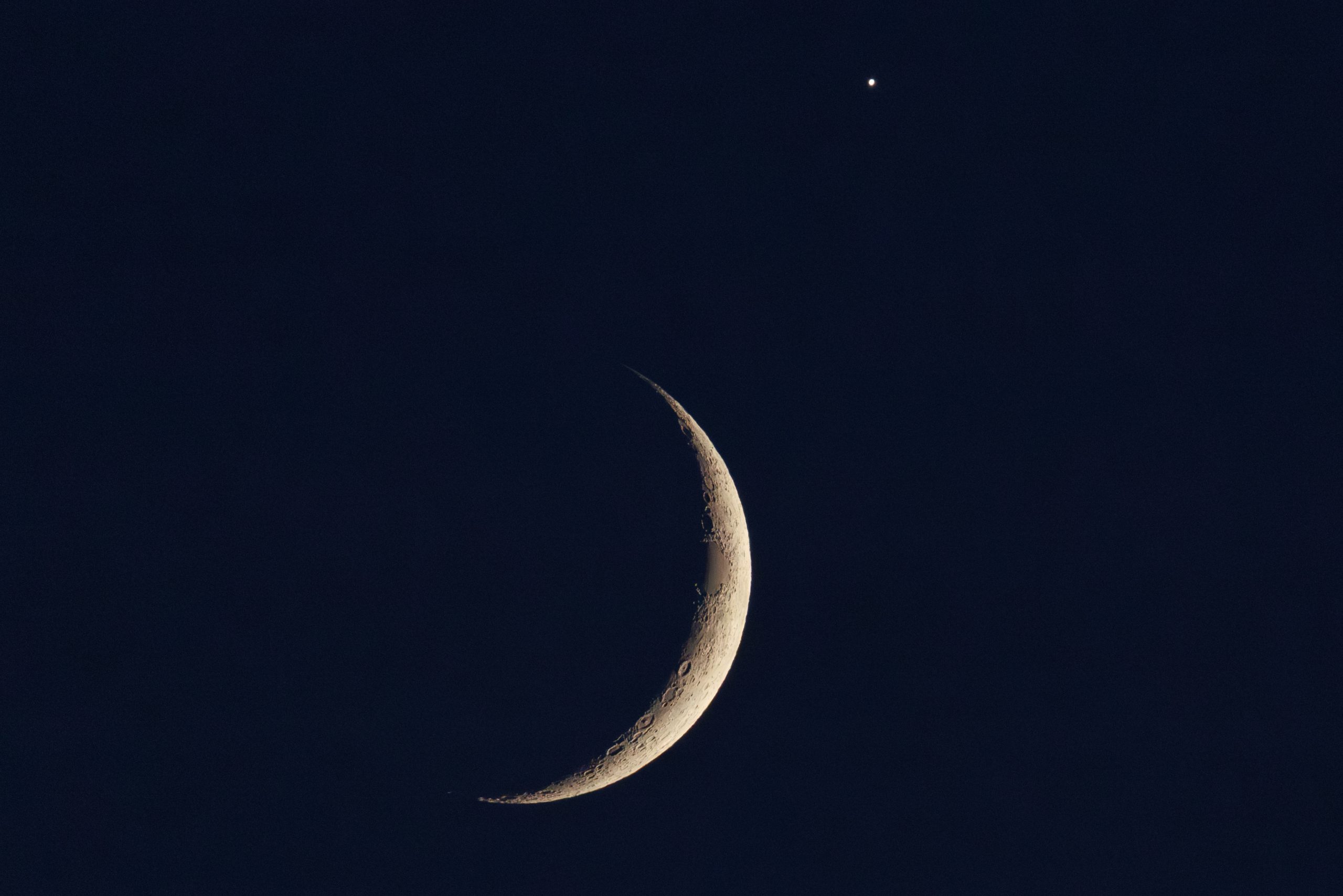
Whenever I look at the crescent or gibbous moon up close like this, I’m always astonished at the details revealed in the almost-shadow—the penumbra—where light gives way to dark. I steadfastly avoid the overused ‘nature-writer’ adjective liminal, but in the unlikely event I were ever tempted to apply it to some location, the moon’s penumbral zone would be the perfect place. Here is an astonishing border-zone between light and dark that reveals details far less visible on either side, namely the moon’s three-dimensional, pockmarked, meteorite-battered surface.
One thing I’m always reminded of whenever I look closely at the moon is Galileo’s wonderful set of wash-drawings of the different phases of the moon, as observed through his newfangled telescope in 1609. Galileo was not the first person to draw the moon with the aid of a telescope—that honour goes to Englishman Thomas Harriot, who made a far simpler sketch a few months before Galileo—but Galileo was a far better artist (and self-publicist) than Harriot. He brilliantly portraying the moon as a side-lit, three-dimensional object with a heavily cratered surface: a depiction that was at odds with the then prevailing Aristotelian cosmology, which claimed all heavenly bodies were permanent and incorrupt. I was intrigued by Galileo’s wash-drawings as a boy, having come across them in my Christmas-present copy of James Burke’s book of his TV series Connections—a book which, alongside my following-year-Christmas-present copy of Joseph Bronowski’s book of his TV series The Ascent of Man (which also reproduced Galileo’s wash-drawings), is largely responsible for kindling my interest in the history of science. Many years later, I was thrilled to see Galileo’s original wash-drawings first-hand in a wonderful exhibition on Galileo in Florence.
Another thing I’m always reminded of whenever I look closely at the moon is photographing it through a large telescope on top of one of the science buildings at Durham University in early 1986. (I’m pleased to report I also asked the moon to say cheese on that occasion: my jokes might not be funny, but I am at least consistent.) The photographs were for my physics dissertation, in which I aimed to calculate the depth of a number of lunar craters based on the lengths of their shadows. Nowadays, to make accurate measurements, I would be able to zoom in on a digital image on my computer screen, but my photos were captured on 35mm black and white negatives which I had to insert into slide-mounts and project greatly magnified on to my college room wall so I could measure the shadows with a ruler. There then followed some complex calculations, which I didn’t really understand, having found the necessary equations in an astronomy magazine article, whose author kindly provided me with more details. To my astonishment, my crater-depth results proved to be in the right ballpark.

Leave a Reply