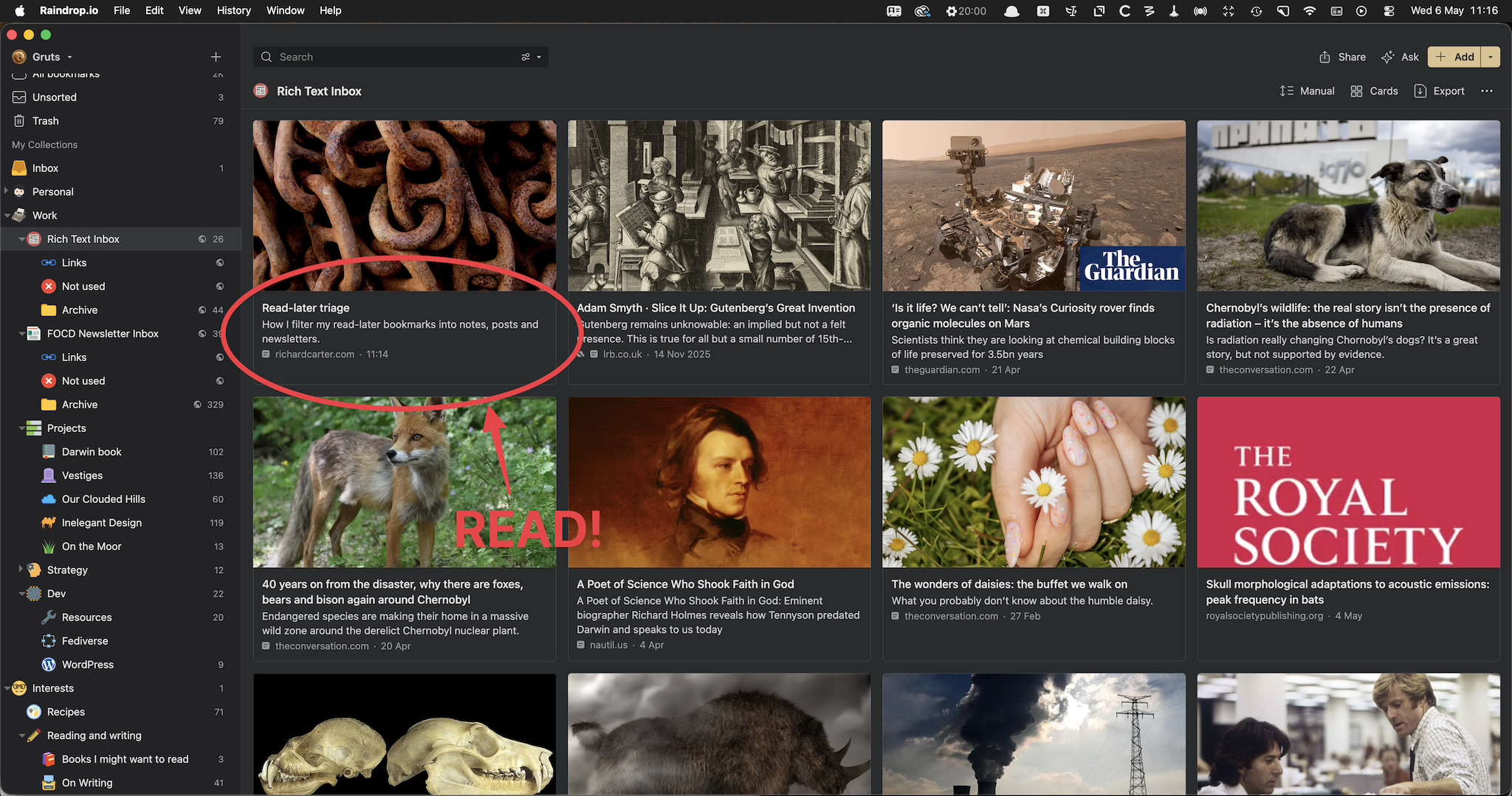
I spent much of the bank holiday weekend reading through articles I’d bookmarked on my read-later app, Raindrop.io. I was surprised at the size of the backlog. As always, an amount of triage was in order: I ended up deleting several articles that no longer seemed relevant; I also saved a decent number for re-consideration when I’m putting together my next newsletter—which should probably be pretty soon, bearing in mind the number of articles I saved.
Curtis McHale recently published a video entitled Read Later is Garbage in which he suggests your read-later app serves little purpose, only making you feel guilty. He’s now experimenting with saving articles directly to his (and my) preferred note-making app, Obsidian, but allowing himself to delete them without guilt if he hasn’t read and made notes from them within a certain time. Obviously, this new approach means he has to be more discerning in which articles he saves for reading later.
I actually quite like how my read-later process works. I’m already pretty discerning about the stuff I save to the app. In general, I only tend to save articles I think might make good newsletter links or are on topics already of particular interest me. Occasionally, I’ll also save articles on stuff I don’t already have notes on but which seem sufficiently interesting to maybe warrant a new note or two.
This weekend, working my way through my read-later list resulted in me making brand new notes on, among other topics:
- Milankovitch cycles;
- the so-called Little Ice Age, and a scientific paper on the Late Antique Little Ice Age;
- Pouyannian mimicry;
- Rob Crawford’s review of the book Roots of Romanticism by Isaiah Berlin;
- Cory Doctorow’s method for making notes for potential future books;
- David Todd McCarty on reclaiming his digital identity;
- an academic paper on Darwin’s relationship with the gardener John Scott;
- an old article by the now disbanded Darwin Correspondence Project on whether Darwin should be considered an early ecologist.
All these new notes logically fitted in with, and ended up being linked to, existing notes in my Obsidian vault. Indeed, that’s why I bookmarked the articles that inspired the notes in the first place: because they were on subjects that impinged and built on topics of interest to me that I’d already made notes about.
Like McHale, I do wonder whether I save too much stuff on my read-later app. To avoid overload, you have to be prepared to put in the triage and set aside time for serious reading. In effect, my process goes through a series of triage steps:
- I monitor my RSS feeds and social media for potentially interesting stuff, but only save individual articles to my read-later app if they’re too long to read immediately, or if I want to consider them later for inclusion in a newsletter;
- about once a week, usually at the weekend, I work though by read-later articles, ditching some and reading others;
- I make notes where appropriate on the articles I read. Sometimes these are proper source and/or topic notes in Obsidian; sometimes I simply record a link to the article in one or more appropriate ‘spark notes’. These are effectively collections of bookmarks on a particular topic of interest that I might possibly want to explore in more depth in future—but quite likely never will;
- I then either delete the original article in my read-later app, or file it there under an appropriate topic. This is the one step in my process I’m beginning to question: will I ever look at these filed articles again? Why not simply delete them? Anything of interest should already be in Obsidian by then. (That said, why not save them? Is it doing any harm?)
One thing I really enjoy about this process is, like this weekend, putting aside some in-depth reading time, sitting down and working my way through a collection of new articles on topics of interest to me. It’s like having my own bespoke newspaper or magazine. It makes you realise that, despite all the AI dreck and other crap out there, there’s still plenty of personally interesting new stuff on the internet, if you’re prepared to perform a bit of triage.
And, given you’ve put in the effort of filtering this stuff, it seems courteous to share it with people who might share your interests by means of social media, blog posts or newsletters.
Which I suppose is what I’ve been doing here.
See also: More of my posts on note-making
Leave a Reply